

Solar vs Traditional Power: The Future of Energy is Changing
Solar vs traditional power is one of the most relevant energy debates today. As industries, governments, and homeowners seek cleaner, more affordable alternatives, it’s crucial to understand how these two energy sources compare in terms of cost, efficiency, and long-term impact.
In this article, we break down the major aspects of solar vs traditional power to help you make informed decisions about your energy investments.
What Is Solar Power?
Solar power harnesses the energy of the sun using photovoltaic (PV) cells to generate electricity. This renewable source of power is clean, abundant, and increasingly affordable thanks to advances in technology and supportive policies.
What Is Traditional Power?
Traditional power typically refers to electricity generated from non-renewable sources like coal, natural gas, oil, and nuclear energy. While these methods have powered the world for over a century, they come with environmental and economic drawbacks.
Cost Comparison – Solar vs Traditional Power
One of the biggest advantages in the debate of solar vs traditional power is the declining cost of solar installations.
🔹 Solar Power Costs:
- Upfront costs include solar panels, inverter, installation, and sometimes batteries.
- Long-term costs are minimal due to low maintenance and zero fuel costs.
- Payback period: 4–7 years for most industrial and residential setups.
According to the International Energy Agency (IEA), solar is now the cheapest source of electricity in history in many countries.
Traditional Power Costs:
- High and fluctuating fuel prices (coal, oil, gas)
- Transmission losses and infrastructure maintenance add to the cost
- Environmental compliance and carbon taxes increase operating costs
Over a 25-year period, solar wins in terms of lower levelized cost of electricity (LCOE).
Efficiency Comparison – Solar vs Traditional Power
🔸 Solar Efficiency:
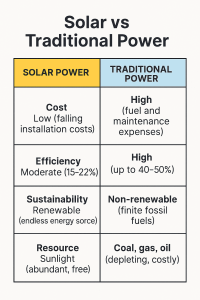
Modern solar panels have an efficiency of 17%–23%, with emerging technologies promising up to 30%. While this may seem low, the availability of free solar energy offsets the lower efficiency percentage.
🔸 Traditional Power Efficiency:
Coal-fired power plants have thermal efficiencies of around 33%–40%. However, the production and transport of fossil fuels involve significant energy losses, making the overall process less efficient than it appears.
When comparing solar vs traditional power, solar may be slightly less efficient on paper, but its operational simplicity and direct conversion of sunlight into energy make it more practical and scalable.
Environmental Impact – Solar vs Traditional Power
In the solar vs traditional power comparison, environmental sustainability is where solar clearly outshines fossil fuels.
✅ Solar Power:
- Zero emissions during operation
- Minimal water usage
- Panels are recyclable and require little space for rooftop setups
❌ Traditional Power:
- Major contributor to CO₂ and greenhouse gas emissions
- High water consumption for cooling
- Causes air pollution, acid rain, and health issues
The shift from traditional power to solar is essential to meeting global climate targets.
Reliability and Scalability – Solar vs Traditional Power
Solar Power:
- Works best in sunny regions but can be scaled with batteries and hybrid systems
- Decentralized (rooftop) setups reduce grid dependency
Traditional Power:
- Provides base-load supply but depends heavily on fossil fuel logistics
- Vulnerable to fuel price volatility and regulatory pressure
As battery storage becomes more advanced, solar is becoming just as reliable as traditional power—with added flexibility.
Government Support & Policy – Solar vs Traditional Power
Governments worldwide are increasingly favoring solar over traditional power through supportive policies:
- Tax incentives for solar installations (e.g., accelerated depreciation)
- Net metering to credit solar users for excess power
- GST rebates on solar components in several countries
| Factor | Solar Power | Traditional Power |
| Cost | Low (after payback) | High & variable |
| Efficiency | 17%–23% (direct) | 33%–40% (with losses) |
| Environmental | Clean & green | Polluting & resource-heavy |
| Government Support | Strong incentives | Increasing regulation |
| Scalability | Modular & decentralized | Centralized & rigid |
Conclusion
The energy transition is here. Whether you’re a homeowner, a business, or a policymaker, understanding the benefits of solar vs traditional power is key to making smart energy choices. Solar power stands out as the cleaner, cheaper, and more sustainable option for a future-ready world.