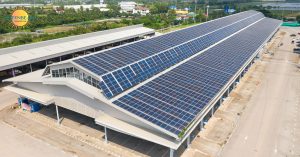

Industrial rooftop solar refers to solar photovoltaic (PV) systems installed on the rooftops of manufacturing units, factories, and other large industrial buildings. These systems convert sunrays directly into electricity, allowing industries to power their operations using clean, renewable energy.
As the demand for cost-effective and sustainable power sources grows, industrial rooftop solar has emerged as a smart solution for energy-intensive businesses.
Industrial electricity tariffs are significantly higher than residential or agricultural tariffs. With rooftop solar, industries can slash their electricity bills by up to 50–70% over time.
According to India’s Ministry of New and Renewable Energy (MNRE), industries with large roof spaces are ideal for solar installation and can generate a substantial portion of their energy requirements.
The average payback period for an industrial rooftop solar project is 3 to 5 years. After that, companies enjoy nearly free power for the system’s 25-year lifespan.
Adopting industrial rooftop solar can significantly reduce your carbon emissions and help meet sustainability targets.
A single 1 MW solar system can offset over 1,300 tons of CO2 annually.
Solar offers predictable energy production and reduces dependency on grid fluctuations or diesel gensets, improving energy reliability for operations.
The company pays for the system upfront and owns the entire infrastructure.
A third-party solar developer installs and maintains the system. The company pays only for the power consumed.
As highlighted by BloombergNEF, such models are becoming popular due to their asset-light structure.
Industrial rooftop solar in India is supported by various policies and subsidies:
Refer to SECI (Solar Energy Corporation of India) for updates on industrial tenders and schemes.
Ask yourself:
If yes, industrial rooftop solar could be your best investment in both sustainability and profitability.